AI-Native Team Collaboration: Shaping New Roles and Workflows
Discover how Orquesta redefines team roles and workflows in AI-native environments, enabling seamless collaboration with AI agents handling code execution.
AI-Native Team Collaboration: Shaping New Roles and Workflows
With the increasing integration of AI into software development, the traditional roles within a development team are evolving. At Orquesta, we’ve built a platform that highlights these changes by making AI an integral part of the development process. When AI agents write and deploy code, what does the team do? Let’s explore the new roles and workflows emerging in this AI-native landscape.
The Evolution of Team Roles
AI's role in code generation and deployment brings about new positions within development teams. Here’s how Orquesta enables these roles:
-
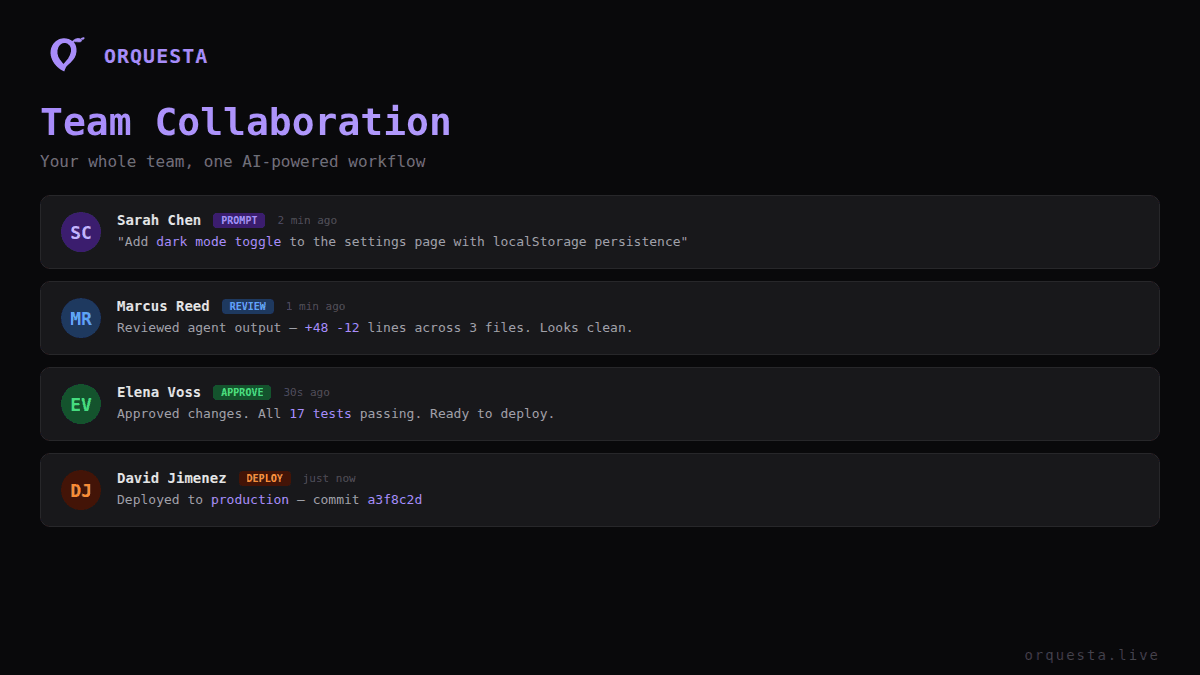
Prompt Authors: These team members specialize in crafting precise prompts that direct the AI agents to generate the desired code. They need to understand both the technical requirements and the nuances of language to communicate effectively with AI.
-
Reviewers: While AI can generate code, human oversight remains crucial. Reviewers ensure that the outputs meet the project’s quality standards and adhere to the guidelines defined in
CLAUDE.md. They utilize Orquesta’s quality gates feature to simulate changes and ensure everything is in order before actual execution. -
Deployers: Once code is approved, Deployers manage its deployment. In Orquesta, they can use Batuta AI for autonomous SSH execution, ensuring the deployment process is efficient and reliable.
New Workflows in Action
The introduction of AI into development workflows doesn’t just create new roles—it reshapes how teams collaborate. Here’s how Orquesta supports these new workflows:
Collaborative Prompt Crafting
A prompt author starts by crafting a prompt in Orquesta’s interface. They can invite other team members to provide feedback or amendments, utilizing Orquesta’s role-based permissions for collaboration. This shared effort ensures the prompt encapsulates the full scope of the task.
{
  "prompt": "Create a REST API for managing user profiles",
  "details": {
    "endpoints": ["GET /users", "POST /users", "PUT /users/{id}", "DELETE /users/{id}"],
    "authentication": "OAuth2"
  }
}
Real-Time Monitoring and Feedback
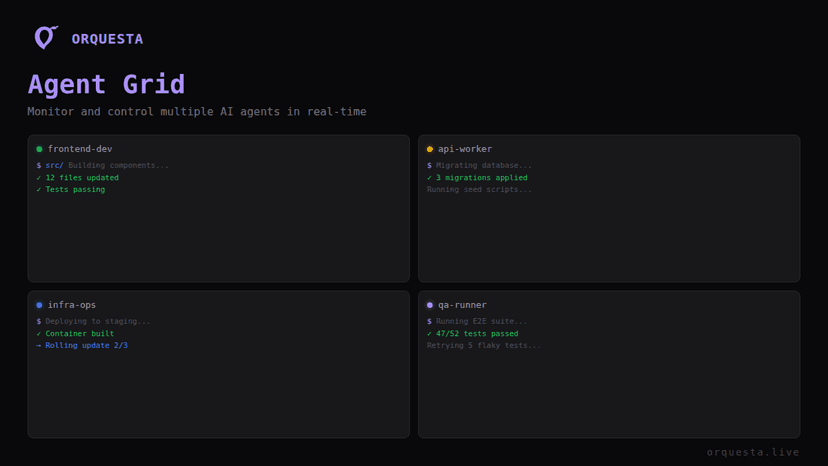
Once the prompt is submitted, the AI agent begins execution. Through the Agent Grid, team members can monitor the AI’s progress in real-time, with every line of code output streamed live. This transparency allows for immediate feedback and adjustments if necessary.
Quality Assurance and Review
With Orquesta’s quality gates, AI-generated code undergoes simulations to predict its impact. Reviewers play a crucial role here, scrutinizing the changes before they’re committed. This step ensures that the final output aligns with the project’s standards and guidelines.
Autonomous Deployments
Deployers use Batuta AI’s ReAct loop to handle deployment autonomously. This feature allows SSH commands to be executed automatically in a loop of thinking, acting, observing, and repeating, minimizing human intervention and potential errors.
Engaging with Non-Technical Stakeholders
Orquesta also facilitates collaboration beyond the development team. Non-technical stakeholders, such as clients, can engage with the process in a meaningful way:
- Feature Requests: Clients or contractors, who might not have SSH access, can submit feature requests through Orquesta’s interface or even via the Telegram bot.
- Feedback Loop: This engagement ensures that the output aligns with client expectations. Clients can also review the live outputs and provide instant feedback, streamlining the development process.
Conclusion
In an AI-native environment, roles and workflows aren’t just about adapting to new tools—they’re about redefining how we collaborate and produce software. Orquesta provides a robust platform that integrates AI into every step of the development process, fostering a seamless and efficient workflow.
As we continue to integrate AI into our workflows, it’s critical to embrace these new roles and processes, ensuring that human oversight and creativity remain at the forefront of software development.
Ready to ship faster with AI?
Start building with Orquesta — from prompt to production in minutes.
Get Started Free →